
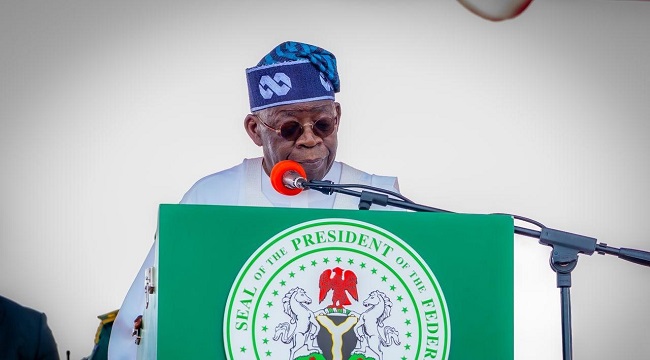
President Bola Tinubu has called on religious and spiritual leaders across the country to consistently speak against terrorism, kidnapping, banditry and the misuse of religion to justify violence.
The President made the call on Sunday in Kano in a goodwill message delivered on his behalf by the Secretary to the Government of the Federation, George Akume, at the Grand Maulud of Sheikh Ahmad Al-Tijani.
Tinubu said religious leaders had an important role to play in confronting violence, extremism and the manipulation of religion for destructive purposes.
He urged religious institutions and their networks to strengthen their efforts in peace education, religious literacy, scholarship and the moral training of young people.
The President also asked clerics to use their influence to promote justice, responsibility, compassion and peaceful ways of resolving grievances.
A statement by his media aide, Yomi Odunuga, quoted Tinubu as saying, “Your voices must be raised consistently against the murder of innocent people, against terrorism, kidnapping, banditry and the misuse of religion to justify cruelty.”
He also urged religious institutions to become more involved in educating young people and protecting them from extremist ideas.
“Your institutions and networks must become stronger in the advocacy for peace education, religious literacy, scholarship and the formation of upright young men and women,” he said.
Tinubu further called on religious leaders to remind political leaders of their responsibilities and citizens of the need to pursue legitimate grievances through lawful means.
“You must also remind political leaders of justice, responsibility and compassion, while reminding citizens that legitimate grievances must never become permission for lawlessness or violence,” he said.
The President added that religious teachings should always uphold the sanctity of human life.
“Above all, our spiritual fathers must continue to teach that no genuine service to Allah is advanced by destroying the innocent human life that Allah has made sacred,” he said.
The call came amid continuing security challenges in Nigeria, including terrorism, kidnapping, banditry and communal violence in different parts of the country.
The North-East has continued to face attacks by terrorist groups, while banditry and kidnapping remain major concerns in several northern states and other parts of the country.
The situation has placed pressure on security agencies and governments at different levels, while religious and traditional leaders have increasingly been called upon to support efforts to prevent violence and promote peaceful coexistence.
Tinubu said the role of religious leaders had become even more important because societies around the world were facing conflicts, uncertainty, climate and food shocks, violent extremism, terrorism, transnational crimes and the manipulation of identity and religion.
He cited a report by the United Nations High Commissioner for Refugees which put the number of forcibly displaced people worldwide at 117.8 million at the end of 2025.
According to the President, the scale of these challenges required religious leaders to play a greater role in preventing conflict and healing divisions within communities.
He described spiritual leaders as people who “guard the frontiers of conscience” because of their ability to help heal wounds, settle grievances and address hatred and bitterness.
Tinubu specifically highlighted the influence of the Tijjaniyya community, which has extensive religious networks across West Africa, North Africa and other parts of the world.
He said the community could use its networks to support reconciliation, counter violent extremism, guide young people and provide humanitarian assistance.
The President said the Federal Government recognised the role of religious and traditional leaders in promoting tolerance, fighting misinformation and identity-based divisions, strengthening peacebuilding at the grassroots and encouraging peaceful coexistence.
He also reaffirmed the government’s commitment to regional cooperation, counter-terrorism, maritime security, economic integration and dialogue.
According to Tinubu, Nigeria’s strategic location at the meeting point of West Africa, the Sahel, the Lake Chad Basin, the Gulf of Guinea and the wider Atlantic region makes its peace and stability important beyond its borders.
“Our position means that peace in Nigeria has consequences far beyond Nigeria. It also means that religious communities with deep transnational connections, such as the Tijjaniyya, can be valuable partners in building an architecture of social peace that complements the work of governments and regional institutions,” he said.
He urged such partnerships to promote truthfulness, compassion, justice, restraint, service and respect for human life.
Tinubu also assured Nigerians that his administration would continue to protect freedom of worship while working with religious and traditional institutions to promote peace, mutual respect and national unity.
The President welcomed the World Khalifa of the Tijjaniyya Order, scholars, spiritual leaders and other guests who travelled from Algeria, Morocco, Senegal, Egypt and other countries for the Maulud.
He described the Tijjaniyya tradition in Nigeria as one with deep roots in scholarship, remembrance, service, moral instruction and peaceful community life.
Tinubu also paid tribute to the late Sheikh Dahiru Usman Bauchi, whose foundation played a major role in organising the Maulud.
Sheikh Dahiru, who died in November 2025, was described by the President as “a teacher, a father and a voice of moderation and reason, and as an advocate of peace and piety.”
Tinubu said the best way to preserve the late Islamic scholar’s memory was to continue his work in Qur’anic scholarship, moral instruction, devotion, respect for learning, peaceful coexistence and concern for society.
He commended the Supreme Council of the Tijjaniyya, the Sheikh Dahiru Usman Bauchi Foundation, the Kano State Government, scholars, traditional rulers, security and emergency services, organisers and volunteers for their roles in the successful hosting of the event.
He also thanked the foreign guests who attended the gathering and prayed for their safe return to their respective countries.
The President’s call for stronger intervention by religious leaders also comes amid renewed debate over the role of faith leaders in Nigeria’s political and governance affairs.
On July 28, the Catholic Bishops’ Conference of Nigeria, led by Archbishop Matthew Ndagoso, met with Tinubu and raised concerns over the country’s security and economic challenges.
Religious leaders have continued to speak on issues affecting the country, including insecurity, poverty, hunger, unemployment and political accountability.
Tinubu’s latest appeal suggests that the Federal Government expects religious institutions to become stronger partners in addressing insecurity and social divisions.
The President’s message also reflects the growing recognition that security cannot be addressed by military and law enforcement measures alone.
Community leaders, clerics and other influential figures can help identify early signs of conflict, discourage young people from joining criminal or extremist groups and promote dialogue between communities.
For the government, religious institutions and traditional authorities, the challenge remains how to turn these calls for peace into practical action at the grassroots.
Tinubu said the values of justice, compassion, restraint and respect for human life should remain central to religious teachings and public life.
He urged religious leaders to continue using their influence to promote peace and discourage Nigerians from allowing religious or political differences to become reasons for violence.