
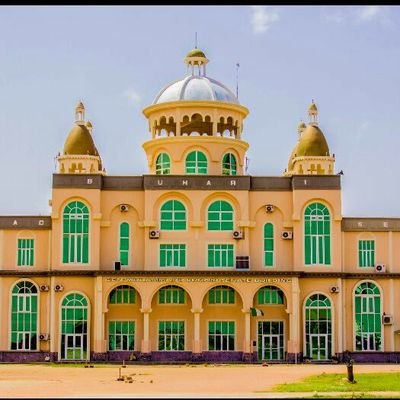
Northwest University Kano, NWUK, has denied a viral claim that the Emir of Kano, Muhammadu Sanusi II, visited the institution to clear an academic carry-over.
The university said the claim was false and urged members of the public to disregard the video and reports circulating on social media.
The institution made its position known in a disclaimer published on its Facebook page on August 10, 2026, and signed by its Public Relations Officer, Abubakar Ibrahim.
The university said it became aware of a viral video showing Sanusi after he attended a public lecture organised by the International Humanitarian Law Society at the institution.
According to the university, the video was initially shared in connection with the lecture, but some social media users later attached captions claiming that the Emir had a carry-over and had gone to the university to clear the alleged academic deficiency.
The institution described the claim as “false, baseless, misleading” and without any factual basis.
“The Management of Northwest University Kano (NWUK) has observed with concern a viral video clip of His Highness, Khalifa Muhammadu Sanusi II, PhD, CON, after attending a public lecture of International Humanitarian Law Society,” the statement said.
The university explained that the event took place at its campus and that the video showed Sanusi after attending the lecture.
However, according to the institution, some individuals subsequently added write-ups to the video and circulated them on different social media platforms.
The posts claimed that the Emir had a carry-over and had approached the university to resolve the alleged academic problem.
“The Management hereby categorically distances itself from the said video, write-ups, and the claims contained therein. The claim is entirely false, baseless, misleading, and without an iota of fact whatsoever,” the university said.
The institution advised members of its community and the general public to ignore the video, captions and related claims.
It stressed that the materials being circulated did not represent the position of the university.
The university also warned individuals against creating, publishing or circulating content that it considered false and defamatory.
It said anyone found to be involved in creating or circulating the alleged false claims would be reported to the appropriate authorities and could face prosecution under applicable laws.
“The public is urged to rely only on official communications from Northwest University Kano for accurate and verified information concerning the University and its activities,” the institution added.
The controversy highlights the growing challenge faced by public institutions and prominent individuals over the spread of unverified information on social media.
Videos from public events can be easily removed from their original context and combined with false captions before being widely circulated on platforms such as Facebook, TikTok, X and WhatsApp.
In many cases, such claims spread quickly because users share the material without checking its source or verifying the information contained in the accompanying captions.
Sanusi, who is one of Nigeria’s prominent traditional rulers, has remained a major public figure since his emergence as Emir of Kano. His background in banking, public service, economics and traditional leadership has also kept him in the public spotlight.
Before becoming Emir of Kano, Sanusi served as the Governor of the Central Bank of Nigeria, CBN, where he was known for his outspoken views on Nigeria’s economy and public finances.
His public profile has continued to attract significant attention, particularly whenever he speaks on economic, social or political issues.
The university did not provide further details about the public lecture attended by the Emir beyond stating that it was organised by the International Humanitarian Law Society.
International humanitarian law generally deals with rules designed to limit the effects of armed conflicts and protect people who are not taking part in hostilities. Public lectures on the subject are often organised by academic institutions, professional groups and civil society organisations to increase awareness of the principles governing armed conflicts.
Sanusi’s attendance at such an event, therefore, was not presented by the university as being connected to any academic deficiency.
The institution’s clarification also sought to separate the Emir’s presence at the event from the claims attached to the viral video.
The university’s warning comes at a time when misinformation and false reports have become major concerns in Nigeria’s digital space.
Social media platforms have made it easier for individuals to publish information without going through the checks normally required by traditional media organisations.
While the platforms have helped institutions and public figures communicate directly with citizens, they have also created opportunities for false information to spread rapidly.
A video can be genuine while the caption attached to it is false or misleading. This can make it difficult for people who encounter the content later to distinguish between the original event and claims added by other users.
The Northwest University case is an example of how such content can create confusion around public figures and institutions.
By issuing the disclaimer, the university sought to correct the impression created by the viral posts and warn members of the public against relying on unofficial information.
The institution also made it clear that it could take legal action against those responsible for creating or spreading defamatory material.
It advised members of the public who want information about its activities to rely on its official communication channels.
The university’s clarification means that Sanusi’s presence at the institution was linked to the public lecture and not, as claimed in the viral posts, to an academic carry-over.
The institution has therefore urged the public to disregard the claim and avoid further circulation of the disputed content.