
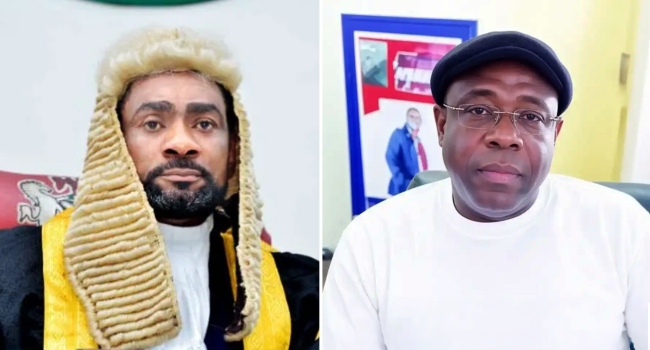
The newly elected Speaker of the Edo State House of Assembly, Yekini Idiaye, has explained why lawmakers forced the resignation of his predecessor, Blessing Agbebaku, accusing him of poor leadership and corruption.
Idiaye, who represents Akoko-Edo Constituency I and is a third-term member of the Assembly, emerged as Speaker on Monday after Agbebaku resigned amid moves by lawmakers to impeach him.
Speaking to journalists after Monday’s plenary, Idiaye said the lawmakers had become dissatisfied with the way Agbebaku handled the affairs of the Assembly.
He alleged that Agbebaku’s leadership was characterised by corruption, frequent and prolonged adjournments and failure to give the Assembly enough time to carry out its legislative duties.
“The House was inaugurated on the 16th of June, 2023 under the leadership of Agbebaku, and since then we have been passing through a lot of challenges, corruption here and there, adjournment here and there, sometimes for 30 days without a cause,” Idiaye said.
“We are not happy with his leadership style. His leadership is poor, and it has been drawing the work of the government backwards.”
Idiaye said the lawmakers were therefore left with no option but to remove Agbebaku from office in the interest of the Assembly and the state.
“That is why we removed him. We must encourage our performing governor. He is doing well, anything that will derail or stop our performing governor, we must stop it,” he said.
“That is why we changed him. I can assure all of you that we will do everything possible to support Governor Monday Okpebholo to move this state forward.”
The change in leadership came amid political developments within the Edo Assembly and followed reports that a majority of the lawmakers had signed an impeachment notice against Agbebaku.
Sources said 17 of the 24 members of the Assembly had signed the notice on Sunday night, indicating that the former Speaker had lost the support of a significant number of lawmakers.
Rather than face impeachment proceedings, Agbebaku reportedly resigned from office on Monday.
His resignation was confirmed by his media aide, Ivy Ebojele, who said details of the development would be made public later.
“I can confirm the Speaker’s resignation but details will be made public later,” she said.
Following Agbebaku’s resignation, the lawmakers proceeded to elect Idiaye as his replacement.
Idiaye’s emergence was also linked to the zoning arrangement within the Assembly, under which the speakership is expected to move to Edo North Senatorial District when the governor is from Edo Central.
Governor Monday Okpebholo is from Edo Central, while Idiaye represents Akoko-Edo Constituency I in Edo North.
As the oldest member from Edo North, Idiaye was subsequently elected Speaker by his colleagues.
The development marks a major change in the leadership of the Assembly, which has been a key part of the political structure of the state since the current administration came into office.
Agbebaku became Speaker after the inauguration of the 8th Edo State House of Assembly on June 16, 2023.
The Assembly was inaugurated during the administration of former Governor Godwin Obaseki, and Agbebaku emerged as Speaker at a time when political disagreements were already shaping the relationship between the state government and the legislature.
The current change in leadership comes after the 2024 governorship election, which brought the All Progressives Congress to power in Edo State.
Okpebholo defeated the Peoples Democratic Party candidate, Asue Ighodalo, and other contenders in the election and was sworn in as governor in November 2024.
The new administration has since been working with the state legislature on its policies and programmes.
Idiaye’s statement suggests that the new Assembly leadership intends to maintain a close working relationship with the governor.
His declaration that the lawmakers would support Okpebholo is likely to shape the relationship between the executive and legislative arms of government in the state.
However, the allegations made against Agbebaku are yet to be independently established. Idiaye did not provide specific details or evidence of the alleged corruption during his interaction with journalists.
Agbebaku and his supporters may also have an opportunity to respond to the allegations.
The claim of prolonged adjournments is, however, one of the issues raised by Idiaye in explaining the decision of lawmakers to change the leadership.
The Speaker said some sittings were allegedly adjourned for as long as 30 days without sufficient reason, a situation he claimed affected legislative activities and slowed down government business.
He argued that the Assembly should be focused on its constitutional responsibility of making laws, considering policies, scrutinising government activities and representing the interests of the people.
The leadership change therefore appears to have been driven by a combination of political and legislative concerns, as well as the zoning arrangement within the Assembly.
The development is also expected to attract attention because of the role of state Houses of Assembly in maintaining checks and balances within government.
Under the Nigerian Constitution, state lawmakers are responsible for making laws for their states, approving budgets and carrying out oversight functions over the executive arm.
The Speaker, as the head of the Assembly, plays an important role in coordinating legislative business and maintaining order during plenary.
The removal or resignation of a Speaker can therefore affect the relationship between the legislature and the executive, especially where there are disagreements over policies, appointments, budgets and other government programmes.
In Edo, Idiaye’s emergence is expected to usher in a new phase in the relationship between the Assembly and the Okpebholo administration.
The new Speaker has already made clear that he intends to support the governor’s efforts to develop the state.
His challenge, however, will be to balance that support with the constitutional responsibility of the Assembly to provide effective oversight of the executive.
For now, attention is expected to focus on how the new leadership handles legislative business and whether the changes will bring stability to the Assembly.
The lawmakers will also have to demonstrate that the allegations that led to Agbebaku’s exit were based on genuine concerns about the performance of the Assembly and not simply political differences.
Idiaye, meanwhile, has pledged to provide a different style of leadership and ensure that legislative activities are not unnecessarily delayed.
With the former Speaker gone and a new leadership in place, the Edo Assembly is now expected to focus on its legislative duties and work with the executive to address the challenges facing the state.