
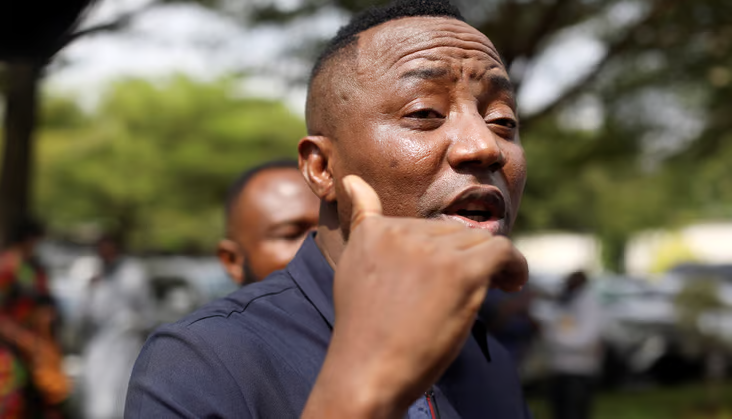
The presidential candidate of the African Action Congress, Omoyele Sowore, has said it is not too late for former military Head of State, Ibrahim Badamasi Babangida, to be arrested and prosecuted over alleged crimes committed during his years in power.
Sowore made the call in a post on his verified X handle on Thursday, as Babangida marked his 85th birthday.
The human rights activist argued that Babangida’s age should not prevent him from facing investigation or possible prosecution over alleged human rights abuses and other violations associated with his military government.
Sowore also cited the case of former Chilean dictator, Augusto Pinochet, who faced arrest and extensive legal proceedings in his 80s, as an example of how advanced age should not automatically prevent accountability.
“It is not too late to arrest and prosecute IBB. He is 85. His age should not confer immunity from justice,” Sowore wrote.
“The unresolved killings, abuses, corruption, and other grave violations associated with his regime deserve proper investigation and, where the evidence supports it, prosecution.”
Babangida, popularly known as IBB, ruled Nigeria as military President from August 1985 until August 1993.
His government came to power after overthrowing the administration of Major General Muhammadu Buhari and remained in power for eight years.
The Babangida years remain one of the most debated periods in Nigeria’s political history.
His administration introduced major political and economic reforms but was also criticised over alleged human rights violations, political repression and controversial decisions that affected the country’s democratic development.
One of the most disputed events of his administration was the annulment of the June 12, 1993 presidential election widely believed to have been won by the late Chief Moshood Kashimawo Olawale Abiola.
The election was considered one of the freest and fairest elections in Nigeria’s history, but Babangida annulled the result before the winner could be declared.
The annulment triggered widespread protests and political unrest across the country.
The crisis eventually contributed to Babangida’s decision to step aside as military President in August 1993.
The June 12 election remained a major political issue for decades before the Federal Government under former President Muhammadu Buhari officially recognised Abiola as the winner and declared June 12 as Nigeria’s Democracy Day.
Babangida has repeatedly defended his decisions while in office and has offered explanations for some of the controversial events of his administration.
He has also remained an influential figure in Nigeria’s political discussions despite leaving office more than three decades ago.
Sowore’s latest comments are part of his long-standing criticism of military rule and what he considers a lack of accountability for abuses committed during Nigeria’s years under military governments.
Nigeria was governed by the military for several periods after independence, with military regimes controlling the country for a significant part of its post-independence history.
Military rule ended in 1999 when General Abdulsalami Abubakar handed over power to an elected civilian government led by former military Head of State, Olusegun Obasanjo.
Since the return to democracy, calls for accountability over alleged abuses committed during military rule have continued.
Human rights groups and activists have repeatedly demanded investigations into unresolved cases involving killings, unlawful detention, torture, corruption and other alleged violations.
However, bringing former military leaders to account has remained difficult because of legal, political and practical challenges.
Sowore’s reference to Pinochet was intended to support his argument that age should not be used as a reason to prevent investigations or legal action.
Pinochet ruled Chile from 1973 to 1990 after taking power in a military coup.
He was arrested in Britain in 1998 at the age of 82 following an extradition request from Spain.
Although he was later released on health grounds and returned to Chile, the case led to further legal proceedings and renewed international attention to alleged human rights violations committed during his rule.
Sowore argued that the example showed that former leaders could still be held accountable even at an advanced age.
His demand comes at a time when Babangida’s birthday has again drawn attention to his political legacy.
The former military President has continued to attract both praise and criticism from Nigerians.
Supporters of his administration often point to the economic and political reforms introduced during his tenure.
His government implemented the Structural Adjustment Programme, a major economic policy introduced in the 1980s with the aim of restructuring the Nigerian economy and reducing dependence on oil.
The programme included measures such as currency reforms, trade liberalisation and the removal of some government controls.
However, the policies also generated hardship and public opposition, particularly because of their impact on prices, wages and living conditions.
Babangida’s administration also established several institutions and introduced reforms in different sectors, while attempting to guide the country towards civilian rule.
The political transition programme, however, was repeatedly extended and became increasingly controversial.
The annulment of the June 12 election remains perhaps the most lasting controversy associated with his administration.
Sowore’s comments therefore place the question of historical accountability back in the public debate.
The AAC presidential candidate has consistently criticised successive governments over corruption, insecurity, human rights and poor governance.
He has also advocated for greater accountability by public officials and has often used social media to make strong demands for investigations and reforms.
For Sowore, the issue is not simply about Babangida’s age but about whether alleged violations committed by political leaders should remain unresolved because the individuals involved are now elderly.
His demand, however, does not amount to a legal finding that Babangida committed the alleged offences.
Any investigation or prosecution would require relevant authorities to establish the facts, determine whether offences were committed and establish whether there is sufficient admissible evidence to support criminal proceedings.
The Nigerian legal system also provides safeguards for anyone accused of a crime, including the right to a fair hearing.
As Babangida celebrates 85 years, the debate over his legacy is likely to continue.
For his supporters, he remains a major figure who shaped Nigeria’s political and economic history during a difficult period.
For critics such as Sowore, however, the unresolved allegations associated with his government should not be forgotten simply because decades have passed.