
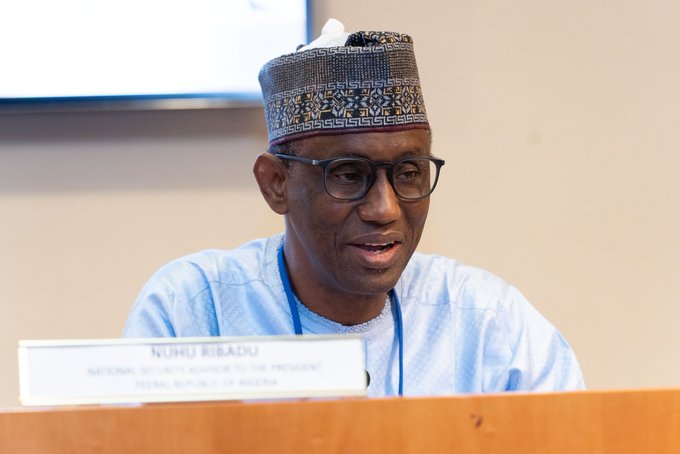
National Security Adviser, Nuhu Ribadu, has identified the spread of illegal small arms and light weapons as a major factor driving insecurity, banditry, terrorism and communal violence across Nigeria.
Ribadu said the easy availability of illicit weapons was helping to sustain violent crimes in different parts of the country, making it difficult for security agencies to restore lasting peace.
The NSA spoke on Thursday in Abuja at a workshop reviewing lessons from Nigeria’s 2016 National Baseline Survey on Illicit Small Arms and Light Weapons.
He said Nigeria needed to understand the scale and movement of illegal weapons in the country to develop effective measures to tackle the problem.
“The proliferation of illicit small arms and light weapons is not an abstract policy concern. It is a deadly threat to the safety of our people,” Ribadu said.
“Behind every statistic on illicit weapons is a community that has lost its peace, a family that has lost a loved one or a livelihood that has been destroyed.”
According to him, illegal weapons are contributing to different forms of insecurity depending on the region.
He linked the proliferation of arms to banditry in the North-West, farmer-herder and communal conflicts in the North-Central and terrorism and insurgency in the North-East.
Ribadu said the continued circulation of illegal weapons had made conflicts more deadly because criminal groups and other violent actors could easily obtain firearms and ammunition.
He stressed the need for accurate and current information to enable the government to respond effectively.
According to him, Nigeria should not rely on estimates when dealing with a security threat as serious as the illegal arms trade.
He said reliable data would help security agencies understand where illegal weapons were coming from, how they were being moved and where they were being used.
Ribadu recalled that the 2016 National Baseline Survey had provided important information about the scale and nature of illegal arms circulation in Nigeria.
The findings from the survey, he said, contributed to the development of government policies and initiatives, including the establishment of the National Centre for the Control of Small Arms and Light Weapons and the development of a National Action Plan.
However, the NSA said the government should not immediately embark on another survey without first reviewing the previous exercise.
He called for an honest assessment of the successes and shortcomings of the 2016 survey before a new baseline study is conducted.
“Before we launch into the next National Baseline Survey, we owe ourselves the discipline of an honest review. What worked? What did not? And what must be done differently this time?” Ribadu asked.
He said lessons from the previous survey would help ensure that a new exercise produces more useful and reliable information.
The NSA said an updated and credible survey would also help security agencies track illegal weapons within Nigeria and across the country’s borders.
Such information, he added, would strengthen efforts to control the movement of arms and support disarmament programmes.
Nigeria shares borders with Benin, Niger, Chad and Cameroon, making cross-border movement an important part of efforts to control the illegal flow of arms.
The country is also located close to regions where terrorism and armed conflicts have created opportunities for weapons trafficking.
Ribadu therefore called for the involvement of all relevant stakeholders in the planned exercise.
He said security agencies, governments at all levels, traditional and religious leaders, civil society organisations and local communities should contribute to the process.
According to him, the problem of illegal weapons cannot be addressed by the Federal Government or security agencies alone.
The Director-General of the National Centre for the Control of Small Arms and Light Weapons, DIG Johnson Kokumo (retd.), said Nigeria’s security situation had changed significantly since the 2016 survey.
Kokumo said new forms of crime had emerged while trafficking routes had also changed.
He therefore said updated information was necessary to reflect the current security situation.
According to him, the proposed survey should provide information on the scale, sources and distribution of illegal weapons across Nigeria.
It should also examine the factors responsible for the spread of illicit arms and identify areas where government intervention is most urgently needed.
Kokumo’s position reflects the changing nature of insecurity in Nigeria over the past decade.
While terrorism and insurgency remain major security threats, the country has also witnessed a rise in banditry, kidnapping, communal violence and other forms of armed crime.
Many of these crimes involve the use of small arms and light weapons, which are easier to obtain and conceal than heavier weapons.
The Director and Deputy High Representative of the United Nations Office for Disarmament Affairs, Dr Adedeji Ebo, also stressed the importance of updated information.
Ebo said Nigeria could not properly assess its current security challenges using data from 2016 alone.
He said reliable information was required to determine the types and number of illegal weapons in circulation, identify trafficking routes and understand the effect of illicit arms on communities.
“Government interventions designed without aggregated and reliable data risk not being deployed in the areas where they are most needed,” Ebo said.
He urged the government to ensure that the new survey was comprehensive and inclusive.
Ebo called for the participation of traditional and religious leaders, women, young people, farmers, fishers, artisans and survivors of armed violence.
He said the experiences of people living in communities affected by violence would provide valuable information for understanding the sources and effects of illegal weapons.
The call for a new survey comes at a time when Nigeria continues to face serious security challenges across several regions.
In the North-West, bandit groups have carried out attacks on communities, kidnapped residents and disrupted farming and other economic activities.
In the North-East, Boko Haram and other insurgent groups have continued to pose security threats, despite years of military operations.
The North-Central has also experienced farmer-herder clashes, communal conflicts and other forms of violence, while kidnapping and armed robbery remain concerns in different parts of the country.
The availability of illegal firearms has often made such conflicts more deadly and prolonged.
Beyond the loss of lives, insecurity has forced many Nigerians to abandon their homes and farms. It has also affected food production, trade, education and other economic activities.
The government has undertaken various measures to seize illegal firearms, prosecute arms traffickers and encourage the surrender of weapons.
However, the continued discovery of arms in the possession of criminal groups indicates that the problem remains significant.
A fresh baseline survey could therefore provide the government with a clearer picture of the current situation and help it develop more targeted responses.
For the exercise to be effective, however, authorities will need to ensure that the data collected is accurate, independently assessed and regularly updated.
The findings will also need to translate into practical action, including stronger border controls, improved intelligence sharing, better tracking of weapons and stronger cooperation among security agencies.
Ribadu’s call for an honest review of the 2016 survey also highlights the need to learn from previous efforts rather than simply repeat them.