
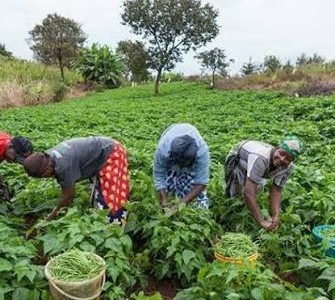
The United Nations has said women account for about 70 per cent of people involved in food crop production, processing and commercialisation in Nigeria, but remain held back by poor access to land, finance, technology, markets and other productive resources.
The UN made this known on Monday at a press conference in Abuja to mark the International Year of the Woman Farmer 2026.
The year is being commemorated under the theme, “Empowering Women Farmers: Advancing Inclusive Policies and Investments for Resilient Agrifood Systems.”
The UN said women play a major role in Nigeria’s food system, from farming and processing to marketing and household food production, but structural barriers continue to limit the benefits they can gain from their work.
It also disclosed that UN-supported projects in Nigeria had reached more than 100,000 women, with about $47 million invested in programmes in which women accounted for between 48 and 50 per cent of beneficiaries.
Speaking on behalf of the Food and Agriculture Organisation Representative in Nigeria and the Economic Community of West African States, FAO Senior Programme Officer, Office of Emergency and Resilience, Jimmy Owani, said women were central to Nigeria’s agriculture and food systems.
Owani said the country could not achieve lasting food security and economic growth without giving women farmers greater opportunities to expand their businesses and control productive resources.
“Women farmers are indispensable to agri-food systems,” he said.
He added that investing in women farmers was “not only a matter of equity, but also a strategic investment in food security, economic growth and sustainable development.”
Owani called for greater investment in women-led agrifood businesses, improved access to land and finance, better technology and extension services, wider market opportunities and stronger participation of women in agricultural decision-making.
The UN Women Country Representative to Nigeria and ECOWAS, Beatrice Eyong, said the contribution of women to agriculture was being limited by long-standing social and economic barriers.
According to her, women have less access than men to land, agricultural knowledge, extension services, technology, finance and markets.
“Though they form 70 per cent of those who provide labour, they have structural constraints, obstacles that make them not to perform the way they should have performed,” she said.
Eyong warned that climate change and the growing pressure on agricultural land could make the situation worse for women.
She said when fertile land became scarce, men were more likely to secure the best available land, leaving women with less productive areas.
“When there is no fertile land, the men are going to get the fertile lands and push women and shift women very, very far,” she said.
According to her, this could increase the distance women travel to their farms and add to the burden of their already heavy workloads.
The UN official also called attention to the unpaid domestic work carried out by women, saying agricultural programmes often fail to consider the time women spend caring for their families.
“Each time you add anything in the village or in the community for women, you have added more work,” Eyong said.
She explained that many women farmers were already responsible for fetching water and firewood, preparing food and caring for children and other family members.
She therefore urged policymakers and development agencies to design agricultural programmes that reduce, rather than increase, the workload of women.
As part of efforts to address some of these challenges, the UN said low-cost biodigesters and other clean-energy equipment had been provided to more than 780 rural women households across six states.
The intervention has helped some women save as much as 12 hours every week that would previously have been spent gathering firewood.
The UN said the use of clean-energy technology could reduce the time women spend on household chores while also helping to protect the environment.
Digital technology is also being used to improve the ability of women farmers to make decisions and access opportunities.
According to the UN, digitally assisted climate-smart agriculture programmes are providing women with information on weather conditions, markets and agricultural inputs.
The programmes are also helping financial institutions assess the credit history of women farmers and enabling agricultural extension officers to monitor farms remotely.
Such measures are important as farmers face growing uncertainty caused by changing weather patterns, flooding, drought and other effects of climate change.
Speaking on behalf of the International Fund for Agricultural Development, the organisation’s Country Director for Nigeria, Dede Ekoue, said UN-supported programmes had also recorded progress in infrastructure and access to technology.
She said more than 221 market, processing and storage facilities were constructed or rehabilitated in 2025.
The programmes also provided more than 4,500 smart-technology and clean-energy equipment.
The equipment included mobile phones, solar-powered water pumps, power tillers and cassava peel conversion machines.
Ekoue said more than 87,888 women belonged to supported rural producer organisations, giving them greater opportunities to work collectively and access markets and other services.
She added that 82 women state apex leaders in 16 states had received leadership training.
The UN also highlighted the progress made by women cooperatives in meeting standards needed to compete in wider markets.
Five women cooperatives received the African Organisation for Standardisation Dual Quality Mark Certification.
The UN said the certification could increase consumer confidence, improve the competitiveness of the cooperatives and help them gain access to regional markets under the African Continental Free Trade Area.
On land and climate resilience, the UN said 21,015 hectares had been rehabilitated and placed under climate-resilient agricultural practices.
About 6,500 hectares had also been facilitated for women and young people, while interventions had protected 203 small-scale farmers from seasonal flooding.
Access to savings and financial services was another area highlighted by the UN.
It disclosed that approximately N465 million in savings had been mobilised among 21,498 active savers.
A further 23,624 participants received training in Information and Communication Technologies for Development to improve their access to agricultural information and markets.
The UN said the interventions were designed to go beyond simply increasing the number of women involved in agriculture.
The broader goal, it said, was to enable women to own and control productive assets, obtain finance and technology, reduce unpaid labour, develop profitable businesses and take part in decisions affecting agriculture and their communities.
The call comes against the background of Nigeria’s continuing food security challenges.
The country depends heavily on small-scale farmers for food production, while farmers face rising input costs, insecurity, flooding, climate change, poor infrastructure and difficulties accessing finance and markets.
Women play a major role in this system but often have fewer resources than men.
The UN said closing this gap would benefit not only women but the wider economy and food system.
It urged federal and state governments to strengthen gender-responsive agricultural policies and expand women’s access to land, finance, infrastructure, technology, climate information and leadership opportunities.
Financial institutions and private companies were also urged to see women farmers as customers, suppliers, entrepreneurs and investment partners rather than merely as beneficiaries of development programmes.
The UN stressed that women farmers should be recognised for their economic contribution and given the tools needed to expand their businesses.
“Women farmers are not merely beneficiaries of agricultural development. They are economic actors, entrepreneurs, innovators and leaders,” the organisation said.
“When women farmers thrive, Nigeria’s food systems thrive.”
The UN said stronger support for women farmers would help Nigeria build a more resilient food system, improve household incomes, create jobs and strengthen the country’s ability to cope with climate and economic shocks.
It therefore urged stakeholders to use the International Year of the Woman Farmer to move from promises to practical measures that would give Nigerian women greater control over land, finance, technology and markets.