
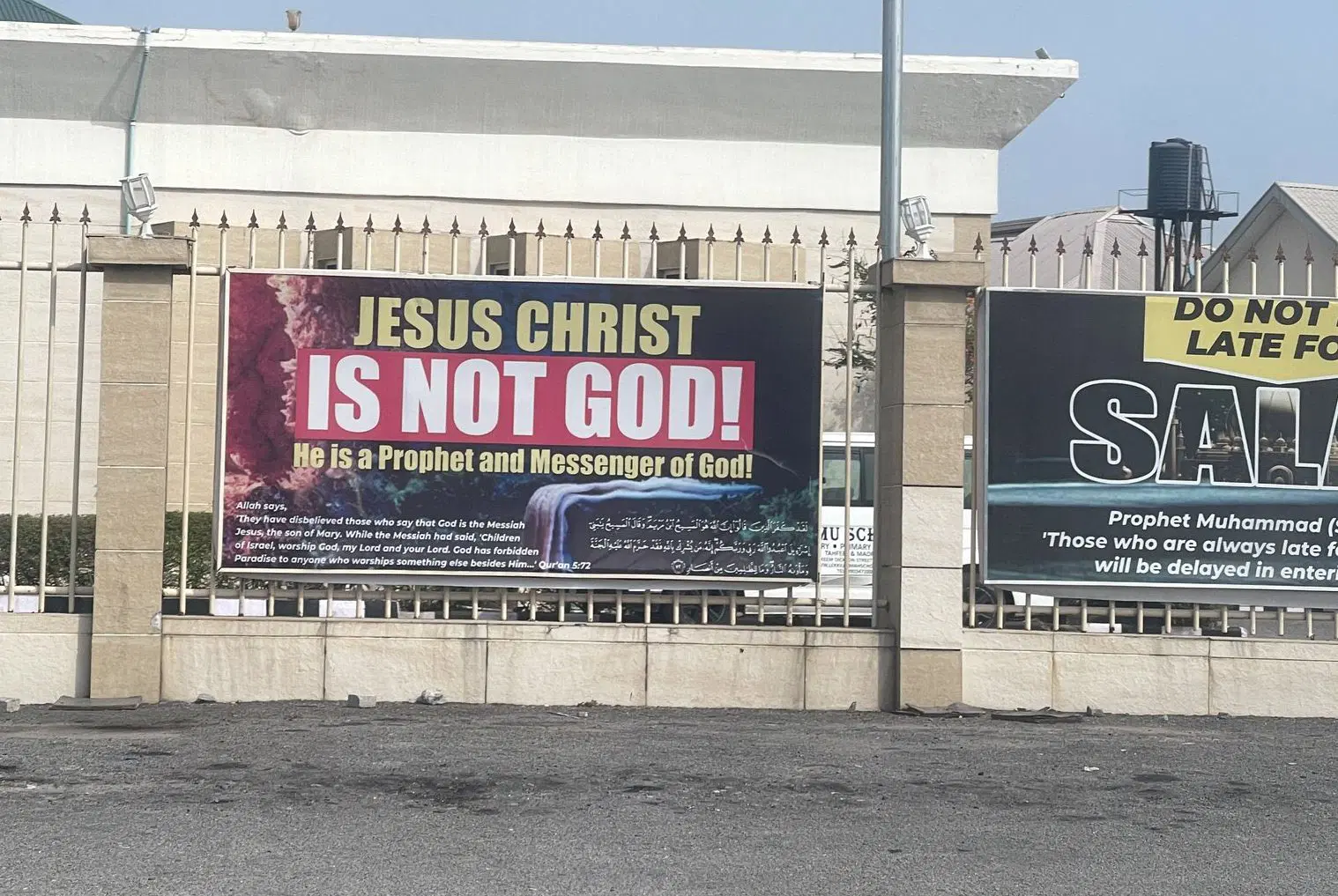
A controversial banner that sparked heated debates in Lagos State has been taken down from the Lekki Central Mosque.
The banner, which read, “Jesus Christ is not God. He is a Prophet and Messenger of God!”, was posted at the mosque’s entrance and quickly went viral on social media, igniting strong reactions from both Muslims and Christians.
A video shared on the social media platform X confirmed the removal of the banner, offering a sigh of relief to many. The video was posted by Adeleke Opeyemi, who captioned it: “The controversial banner has been removed from Lekki Central Mosque. Everyone can rest now… My opinion: No one can fight for God. Religion is a sensitive issue, and we should all take it easy sometimes.”
In the video, Tunde Alabi, a member of the Lekki Muslim Community, confirmed that he personally checked and verified the banner’s removal. Alabi explained that he had been made aware of the public outrage surrounding the banner and had notified the mosque committee. He added that after his request, the committee removed it.
Alabi said, “Good evening, everybody. My name is Tunde Alabi. I’m a member of the Lekki Muslim Community, and I noticed there was a banner posted in front of our mosque that was causing some kind of controversies. I sent a message to the mosque committee, and I was told that it had been removed. So I came here personally to check for myself.”
Alabi, in the video, went on to point at the location where the banner had once been displayed, confirming its removal. He also offered an apology for any inconvenience the banner may have caused. “Let me say I’m sorry for the inconvenience that must have caused. The banner has been removed. Thank you,” he added.
The banner, which made strong religious claims, went viral on Wednesday, stirring widespread debate. While some saw the banner as a reflection of Islamic teachings, others deemed it blasphemous, especially among Christian communities.
The inscription on the banner was seen by many as an attack on the Christian belief in the divinity of Jesus Christ. For some Christians, the claim that Jesus is not God is considered a direct insult. On the other hand, Muslim communities believe that Jesus is one of the greatest prophets, but not divine.
“I was shocked when I saw the banner,” said a local resident, Oja Yemi. “I know that people have different beliefs, but that message was too much. It felt like an attack on Christianity, and it stirred a lot of anger.”
However, others defended the banner, stating that it was merely expressing an Islamic view and was in line with Islamic teachings. According to them, Islam does not recognize Jesus Christ as the Son of God, but as a prophet, and the banner was simply a reflection of that belief.
“The message on the banner reflects Islamic teachings. Muslims believe that Jesus was a prophet and messenger of God. It was not meant to provoke anyone,” a member of the Lekki Muslim Community. “It’s unfortunate that some people misunderstood it.”
As of now, the Lekki Central Mosque has yet to release an official statement on the matter. The lack of an official response from the mosque has led some to question whether the removal of the banner was a result of external pressure or if it was a decision made by the mosque committee.
Some observers believe that the mosque removed the banner to avoid further tension between religious groups. “In today’s world, people are quick to take offense, especially when it comes to religion,” said an anonymous local. “It’s always best to avoid controversy, and I think the mosque acted wisely by removing the banner.”
Despite the banner’s removal, the issue has sparked an ongoing discussion about religious tolerance and respect for differing beliefs. Some argue that religion should not be used as a tool for division, while others maintain that everyone should be free to express their faith as they see fit.
In Nigeria, religion plays a significant role in daily life, with Islam and Christianity being the two largest religions in the country. Lagos State, with its diverse population, is often at the center of religious discussions and debates.
The controversy surrounding the banner highlights the delicate nature of religious dialogue in Nigeria. In a country where religious and ethnic tensions are sometimes high, such incidents can easily escalate into more significant conflicts.
While the removal of the banner has calmed some of the tensions, others are calling for more dialogue between religious communities to prevent similar incidents in the future.
The situation also raises questions about the role of religious institutions in fostering harmony. While some argue that religious leaders should ensure their teachings promote peace and understanding, others believe that faith should be allowed to speak freely, even if it sometimes leads to controversy.