
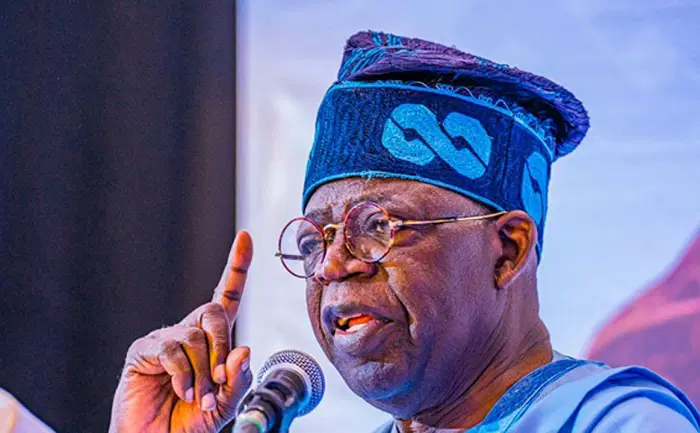
President Bola Ahmed Tinubu on Friday again rejected claims that there is a Christian or Muslim genocide in Nigeria, saying the country’s security problems are not caused by religion but by criminal activities and violent extremism. He said both Christians and Muslims have suffered from insecurity and that efforts to label the crisis as religious are false and dangerous.
The President made these remarks while declaring open the 8th Biennial Conference and Annual General Meeting of the Nasrul-Lahi-l-Fatih Society (NASFAT) in Abuja. The event, which brought together Muslim scholars, community leaders and professionals from across the country, had the theme: “Building Resilience in a Changing World: The Role of Faith and Community.”
Tinubu was represented at the event by the Attorney General of the Federation and Minister of Justice, Mr. Lateef Fagbemi, SAN. In his message, the President said the Federal Government is working hard to end terrorism, banditry and other forms of violent crime that have troubled many parts of Nigeria in recent years.
According to him, allegations of religious genocide are unfounded and capable of damaging the peace and unity of the country. He warned that such claims could inflame passions, increase mistrust among communities and weaken the progress Nigeria has made in promoting peaceful coexistence among its people.
“In recent times, the Federal Government and other persons of goodwill have had to address unfounded allegations,” the President said. “The allegations are not only false, but harmful, and capable of inflaming passions and disrupting the sustenance of the peaceful coexistence which we continue to build as a nation.”
In the past, some international groups and foreign politicians have accused Nigeria of failing to protect Christians, especially in areas affected by insurgency and bandit attacks. At one point, former United States President Donald Trump responded to such allegations by designating Nigeria as a “Country of Particular Concern” over religious freedom issues.
The Nigerian government strongly opposed that designation at the time, insisting that the country does not support or encourage persecution of any religious group. Tinubu recalled this response, saying Nigeria’s position was clear and firm.
“We reaffirmed that our nation does not foster or tolerate policies or actions aimed at persecuting any religious group,” he said.
The President stressed that Nigeria’s security challenges have deep roots in history, economic hardship, unemployment, weak law enforcement and organised crime. He said these problems affect people of all religions and ethnic groups.
“Our security crisis is rooted in historical, economic and criminal issues, not religious issues,” Tinubu said. “Muslims and Christians alike have been victims of terrorism in Nigeria. Muslims and Christians alike stand shoulder to shoulder in condemning violence from any quarter.”
He added that as President, he has a constitutional duty to protect all Nigerians, regardless of their faith or background.
“With all sense of responsibility and fidelity to the constitution, there is no Christian genocide in Nigeria, and there is no Muslim genocide in Nigeria,” he said. “What we have is terrorism driven by criminality, extremism, and challenges we are working tirelessly to overcome.”
Tinubu urged Nigerians to reject narratives that seek to divide the country along religious or ethnic lines. He warned against allowing both internal and external forces to spread stereotypes or false stories about Nigeria.
“We must, therefore, reject narratives that seek to divide us, whether they come from within or outside our borders,” he said. “We must neither allow internal nor external forces to sow discord or feed dangerous stereotypes about our beloved nation.”
He said Nigeria’s greatest strength lies in its diversity and praised organisations like NASFAT for promoting moderation, tolerance and service to humanity. According to him, these values are important tools for resolving conflicts and building national unity.
“Our differences are a divine design, not a source of conflict,” the President said. “Your teachings on moderation, tolerance, and service to humanity provide pathways for resolving conflicts and deepening national unity.”
The President also spoke about the ongoing economic reforms introduced by his administration, including subsidy removal and changes in fiscal and monetary policies. He admitted that many Nigerians are facing hardship as a result of these reforms but said they are necessary for long-term growth and stability.
“While these reforms are necessary for long-term prosperity, I understand the inevitable temporary difficulties many citizens are experiencing,” he said. “Let me assure you that we are working tirelessly to alleviate these pressures, expand social support, and accelerate the benefits of the reforms.”
Tinubu said the government is also reviewing the country’s security architecture to make it more effective and responsive to the needs of citizens across all regions.
He noted, however, that government efforts alone are not enough to build national resilience. He called on faith-based organisations, traditional institutions and community groups to support peace-building and moral values.
“As we reform our economy and tackle insecurity, we rely on institutions like NASFAT to reinforce the moral and spiritual fabric of our society,” he said. “Faith must inspire action.”
The President urged religious leaders to promote peace, reduce tension and counter misinformation, especially on social media. He said faith groups have a responsibility to nurture unity, patriotism and respect for one another.
“We need your continued partnership in promoting peace, reducing tension, countering misinformation, and nurturing the values of unity and patriotism,” he said.
Delivering the keynote address at the conference, Dr. Nurudeen Lemu called on Muslim faithful to remain hopeful and steadfast despite the many challenges facing the country. He urged patience, endurance and stronger cooperation among faith-based organisations to support national development and good governance.
Dr. Lemu said religious bodies must work together, not only to address moral issues, but also to hold leaders accountable and encourage policies that improve the lives of ordinary Nigerians.
Also speaking, the Secretary General of the Nigerian Supreme Council for Islamic Affairs, Prof. Is-haq Oloyede, praised NASFAT for its growth and impact over the years. He described the organisation as “one of the five-star Islamic organisations” in the country.
He added that NASFAT’s influence continues to grow and expressed confidence that it would achieve even greater heights in the future.
“We believe five-star will not be enough, because people are now talking of seven-star, and I believe NASFAT will be there,” he said.
Prof. Oloyede also spoke about the need for Muslims to apply Islamic principles in a way that responds to modern realities. He said the world is changing, and religious understanding must also adapt while remaining faithful to core values.
“The world is changing, and our understanding of Islam must also change with time,” he said. “The application of Islam in the public space must also change.”
The conference ended with prayers for peace, security and economic recovery in Nigeria, as well as a renewed call for unity among all citizens, regardless of religion or ethnicity.