
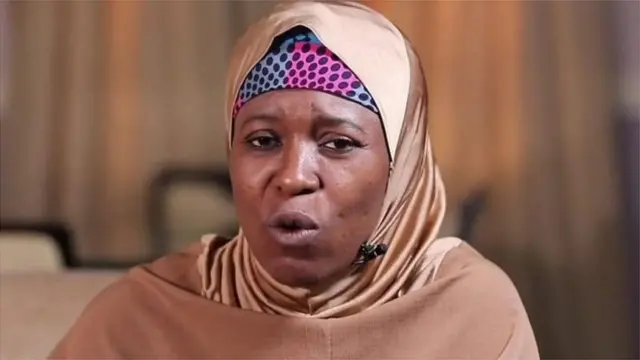
Human rights activist and co-convener of the BringBackOurGirls movement, Aisha Yesufu, has accused members of the Nigerian Senate of enabling what she described as the “evil” being carried out by President Bola Tinubu’s administration.
Yesufu made the remarks in a statement posted on her verified X (formerly Twitter) account on Friday while reacting to comments by Senator Garba Maidoki, who recently lamented the worsening security situation in Kebbi State.
According to the activist, senators should stop portraying themselves as victims because they possess the constitutional authority to hold the Executive accountable.
Instead, she argued, they have continued to support actions of the Federal Government through their legislative decisions.
“Senators should stop infantilizing themselves! They are not victims. They are enablers of whatever evil Tinubu is carrying out in this country,” Yesufu wrote.
“They are the ones giving him the power to do all the shenanigans he is currently doing.”
Her comments followed an emotional appeal by the senator representing Kebbi South Senatorial District, Garba Maidoki, who raised concerns over the growing insecurity affecting communities in his constituency.
Maidoki had disclosed that he stood up during Senate proceedings to draw attention to the attacks by bandits in his district and appealed to Nigerians to assist the affected communities.
According to the lawmaker, residents of several communities have continued to suffer repeated attacks by armed groups, leading to the loss of lives and destruction of property.
His comments reflected growing concern among political leaders from northern Nigeria over the persistent activities of bandits operating across parts of the North-West and North-Central regions.
Banditry has remained one of Nigeria’s most serious security challenges in recent years, particularly in states such as Kebbi, Zamfara, Kaduna, Katsina, Sokoto and Niger.
Armed groups have carried out attacks on villages, schools and highways, killing residents, abducting travellers and demanding ransom from victims’ families.
The violence has displaced thousands of people and disrupted farming activities in many rural communities, contributing to food insecurity and economic hardship.
Although security agencies have intensified military operations against criminal groups, attacks have continued in several affected areas.
The Federal Government has repeatedly assured Nigerians that it remains committed to restoring peace through coordinated security operations, improved intelligence gathering and enhanced collaboration among security agencies.
However, opposition politicians, civil society organisations and many citizens have continued to express concern over the pace of progress in tackling insecurity.
Yesufu argued that lawmakers share responsibility for the direction of governance because they have constitutional powers to scrutinise executive actions, pass or reject legislation and ensure accountability.
According to her, senators cannot distance themselves from government policies while continuing to support the administration through legislative approval.
Her remarks add to ongoing public debate about the role of the National Assembly in Nigeria’s democratic system.
Under the 1999 Constitution, the National Assembly is empowered to make laws, approve budgets, conduct oversight of government agencies and hold the Executive accountable through investigations and other constitutional mechanisms.
Critics, however, have on several occasions accused lawmakers of failing to exercise their oversight responsibilities independently, while supporters of the National Assembly maintain that legislators have continued to perform their constitutional duties.
Yesufu has remained one of Nigeria’s most outspoken civil society voices on issues relating to governance, human rights, elections and public accountability.
She gained national and international recognition as one of the leading figures of the BringBackOurGirls campaign, which demanded the rescue of more than 200 schoolgirls abducted by Boko Haram from Government Girls Secondary School, Chibok, Borno State, in April 2014.
Since then, she has consistently commented on national issues, including elections, insecurity, economic policies and governance.
Her latest remarks are expected to generate debate within political circles, especially as concerns over insecurity continue to dominate public discourse across the country.
The comments also come at a time when Nigerians are increasingly calling on all arms of government to work together to address the nation’s security and economic challenges.
While Senator Maidoki’s appeal drew attention to the suffering of communities affected by bandit attacks, Yesufu’s response has shifted focus to the broader question of the National Assembly’s role in addressing the country’s challenges.
The Presidency and the Senate had not publicly responded to Yesufu’s comments as of the time of filing this report.