
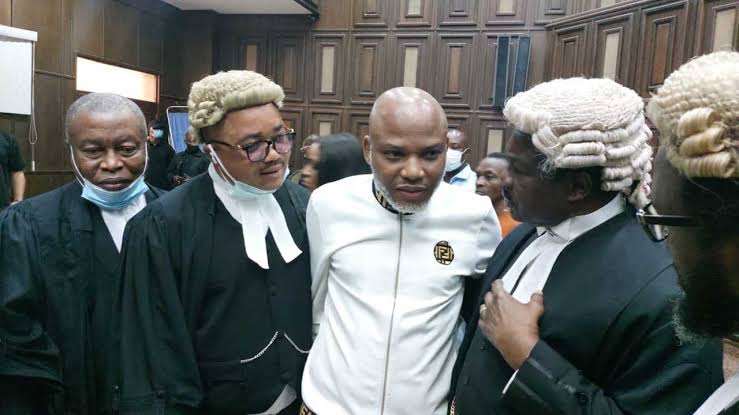
Nnamdi Kanu, the embattled leader of the Indigenous People of Biafra (IPOB), has fiercely rejected a recent ruling by the Court of Appeal that upheld the proscription of the group. Kanu, through his legal team, has made it clear that IPOB will seek redress at the Supreme Court, describing the court’s decision as flawed and unjust.
On Thursday, the Abuja Division of the Court of Appeal affirmed an earlier Federal High Court ruling that declared IPOB a terrorist organization, a verdict that Kanu and his supporters have fiercely contested. According to Kanu’s lead counsel, Aloy Ejimakor, the judgment, in their view, was not only a denial of justice but also a blatant disregard for the Nigerian Constitution.
“This decision shall not stand. It is an absurd judgment that elevates the denial of fair hearing to an unacceptable level,” Kanu said through a statement issued by his legal team. “The Court of Appeal’s ruling will go down in history as a decision that defied basic legal standards and constitutional provisions.”
The legal team emphasized that despite the setback at the appellate level, the decision was far from final. They pointed out that IPOB’s fight is far from over, with the Supreme Court being the next legal battleground. According to Kanu, the final verdict on whether IPOB and its leadership will be branded as terrorists will be determined at this higher judicial level.
“Let me make this very clear,” the statement continued, quoting Kanu, “The judgment passed by the Court of Appeal has no prejudicial impact on our main case. This is not the end. The law mandates that the Supreme Court is the final arbiter in matters such as this, and that’s where we are headed.”
Kanu’s legal representatives have raised significant concerns about the process through which IPOB was proscribed. They argue that the proscription order was granted in a manner that violated IPOB’s constitutional right to a fair hearing. The order was made via an ex parte application, without IPOB being notified or given the opportunity to present its case before the court. Furthermore, the legal team contends that the proscription directive, which was issued by the Attorney-General, was not signed by former President Muhammadu Buhari, as stipulated by the law, but by the late Abba Kyari, the former Chief of Staff to the president.
Despite acknowledging these procedural lapses, the Court of Appeal dismissed IPOB’s appeal, ruling that national security concerns justified overriding constitutional provisions. The court maintained that the alleged actions of IPOB in 2017 posed a significant threat to Nigeria’s national security, making the suspension of certain constitutional rights necessary. However, Kanu’s team rejected this justification, stating that the ruling was discriminatory and politically motivated.
“The judgment is an affront to the Constitution and a targeted attack on the Igbo people,” Kanu’s statement argued. “In our view, this ruling is not just about IPOB. It’s about a systemic violation of the rights of the Igbo and their legitimate aspirations for self-determination.”
The appeal to the Supreme Court, according to IPOB’s leaders, is not just about the legality of the proscription but also about a broader struggle for the fundamental rights of the Igbo people. Kanu’s team has warned that anyone who seeks to use the Court of Appeal’s judgment to further vilify Kanu or the IPOB group as a terrorist organization will face severe legal consequences. The legal team has vowed to employ all available legal avenues to fight against what they see as a defamatory label.
“The legal battle does not end here,” said Ejimakor in his statement. “We will not sit idly by while attempts are made to use this unjust ruling to inflict legal harm on Mazi Nnamdi Kanu and the Igbo people. We will take every possible action to ensure that this dangerous narrative is countered.”
Kanu and his supporters have long maintained that IPOB is a peaceful organization fighting for the legitimate rights of the Igbo people. They have consistently rejected accusations of terrorism, arguing that their cause is one of self-determination and justice, not violence.
Despite the court’s decision, Kanu remains resolute, believing that the Supreme Court will overturn the ruling and restore the legitimacy of IPOB’s cause. His legal team is already preparing for the appeal, with a particular focus on the constitutional irregularities that they argue marred the lower court’s decision.
In their defense, IPOB’s legal representatives argue that the actions attributed to IPOB in 2017, including protests and civil disobedience, do not meet the internationally recognized definitions of terrorism. Furthermore, they insist that the Federal Government’s approach to handling the situation, through what they consider to be an unlawful proscription, violates Nigeria’s commitment to human rights and the rule of law.
“We believe the facts are clear. There was no evidence presented in the lower courts to justify the claim that IPOB was engaged in terrorism,” said Ejimakor. “We will make our case in the highest court in the land, where justice will prevail.”
The next steps in this high-profile case will be closely watched, with many Nigerians waiting to see how the Supreme Court will rule on this contentious issue. For now, Kanu’s legal team remains hopeful that the highest court will rule in their favor and overturn what they consider to be an unjust decision.
As the legal battle continues, Kanu’s supporters remain steadfast in their belief that their leader’s fight is far from over. For them, the struggle for Biafra’s self-determination is deeply tied to a broader fight for justice and respect for constitutional rights. The future of IPOB and Kanu’s leadership will likely hinge on the Supreme Court’s judgment in the coming months, with both sides gearing up for what promises to be a monumental legal showdown.
In the meantime, Kanu’s camp has issued a stern warning to anyone attempting to use the recent court ruling to malign IPOB or its leader. “Until the Supreme Court has the final say, any claim that Kanu or IPOB is a terrorist will face swift legal action,” they said.