
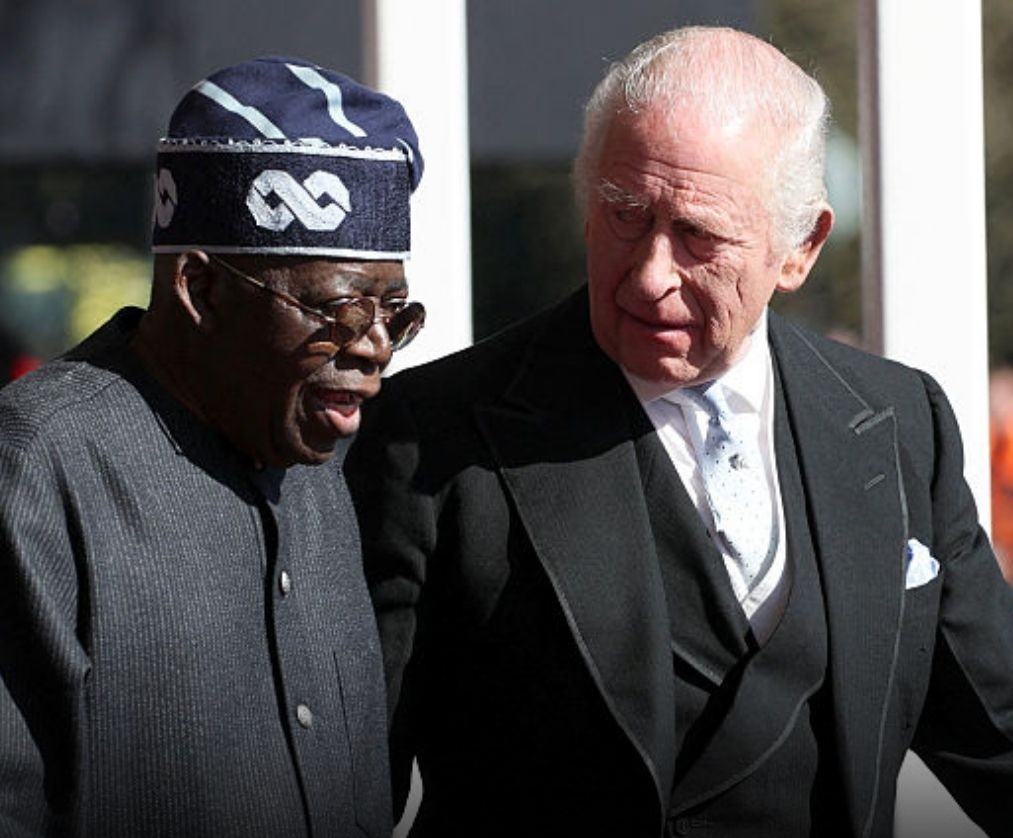
President Bola Ahmed Tinubu has reaffirmed the long-standing relationship between Nigeria and the United Kingdom during a state banquet held at Windsor Castle, describing the partnership as one built on shared history, values, and a common vision for the future.
Speaking before King Charles III, Queen Camilla, and other members of the British royal family, Tinubu said it was a great honour to represent Nigeria at the historic venue, noting that he is the first Nigerian leader to deliver such an address at Windsor Castle.
The president expressed appreciation for the warm reception given to him, his wife, Oluremi Tinubu, and the Nigerian delegation. He described the moment as significant not only for him personally but also for Nigeria as a country.
Tinubu used the occasion to reflect on the deep historical ties between Nigeria and the United Kingdom, which date back several centuries, including the colonial period before Nigeria gained independence in 1960. He noted that despite the complex past, both nations have continued to build a relationship based on mutual respect and cooperation.
According to him, Britain has played a key role in shaping modern democratic governance around the world. He referenced the Magna Carta as an important milestone that laid the foundation for the rule of law and accountable government.
The president also acknowledged the influence of prominent British thinkers such as Thomas Hobbes, John Locke, and Edmund Burke, whose ideas have shaped democratic systems globally. He added that literary figures like William Shakespeare and Charles Dickens have contributed to the global spread of the English language, which remains widely spoken in Nigeria.
Tinubu explained that many of Nigeria’s institutions still reflect British influence. He said Nigeria’s legal system draws from English common law, while its parliamentary and civil service structures are rooted in traditions developed in Britain but adapted to local realities.
The president, however, stressed that beyond institutions, the strongest link between both countries lies in their people. He highlighted the contributions of Nigerians living in the United Kingdom, especially in critical sectors such as healthcare.
He noted that Nigerian doctors and nurses form a significant part of the workforce of the National Health Service, playing an important role in delivering medical services across the country.
Tinubu also pointed to the success of individuals of Nigerian heritage in sports, mentioning athletes such as Maro Itoje, Bukayo Saka, Eberechi Eze, and Anthony Joshua as examples of the strong human connection between both nations.
The president further highlighted Nigeria’s commitment to the Commonwealth of Nations, a group of 56 countries led by the British monarch. He said Nigeria, as one of the largest members, is ready to contribute to the growth and development of the organisation.
On security, Tinubu spoke about the challenges facing West Africa, particularly terrorism linked to instability in the Sahel region. He said Nigeria carries a major responsibility in ensuring regional stability and noted that cooperation with the United Kingdom remains important in addressing these threats.
He also disclosed plans to meet with British Prime Minister Keir Starmer to further strengthen bilateral relations, especially in areas of security and development.
Despite the challenges facing Nigeria, Tinubu expressed optimism about the country’s future. He described Nigeria as a nation full of energy, with a growing population of young people, entrepreneurs, and innovators who are eager to succeed on the global stage.
In a personal reflection, the president recalled his time in exile during Nigeria’s military era, when he sought refuge in the United Kingdom. He expressed gratitude to the British government for the support given to pro-democracy activists during that period, noting that such solidarity played a role in Nigeria’s return to democratic rule in 1999.
Tinubu said it was deeply meaningful for him to now stand before the British monarch as the elected leader of a democratic Nigeria, describing it as a full-circle moment in his political journey.
He concluded his speech by thanking the royal family and the people of the United Kingdom for their continued friendship with Nigeria. Raising a toast, he called for stronger ties and a brighter future for both nations, expressing confidence that the relationship would continue to grow.
The state banquet at Windsor Castle forms part of ongoing diplomatic engagements aimed at strengthening Nigeria-UK relations, which cover trade, security, education, and cultural exchange. Analysts say such high-level interactions are important in maintaining cooperation between both countries, especially in a rapidly changing global environment.