
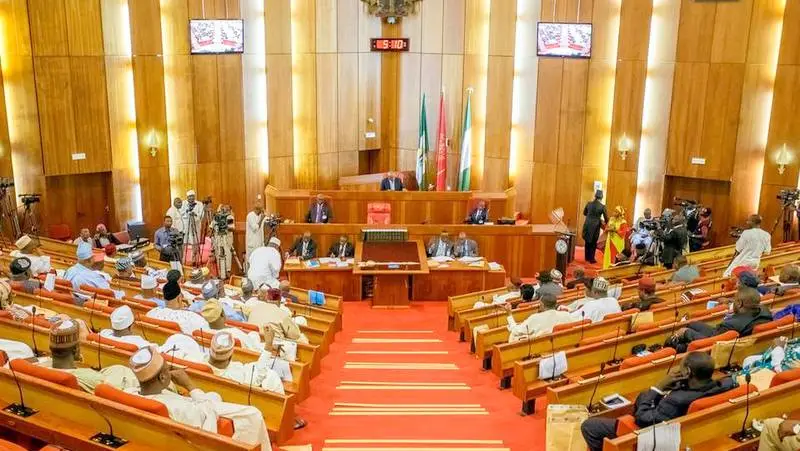
The Nigerian Senate has issued a firm deadline of April 29, 2026, to the Nigerian National Petroleum Company Limited (NNPCL) to explain discrepancies amounting to N210 trillion identified in audit reports covering a seven-year period.
The directive was given on Wednesday by the Senate Committee on Public Accounts following a meeting at the National Assembly in Abuja. Lawmakers say the oil company must provide clear and detailed explanations for the figures, which have raised serious concerns about transparency and accountability in Nigeria’s most important revenue-generating sector.
Chairman of the committee, Aliyu Wadada, said the Senate was not satisfied with earlier responses submitted by the NNPCL. He insisted that Nigerians deserve full disclosure, not vague or general statements.
The committee has summoned the current Group Chief Executive Officer of NNPCL, Bayo Ojulari, to appear before it on the stated date. He is expected to attend alongside his predecessor, Mele Kyari, and other former top officials of the company.
Among those also invited are former Chief Financial Officer, Umar Ajia, Managing Director of the Petroleum Products Marketing Company (PPMC), Bala Wunti, as well as external auditors who handled the company’s accounts during the period under review.
The controversy centres on 19 audit queries flagged between 2017 and 2023. According to the Senate committee, these queries point to financial discrepancies totalling N210 trillion — a figure that has sparked public debate given Nigeria’s economic challenges and dependence on oil revenue.
The NNPCL had earlier responded to the queries by stating that N103 trillion of the amount represented liabilities, while N107 trillion was spent on Joint Venture Cash Calls — funds used to finance oil production partnerships between the government and private oil companies.
However, the Senate committee rejected these explanations, describing them as incomplete and lacking the necessary details.
Wadada said the classification of N103 trillion as “liabilities” was not acceptable without a proper breakdown. He explained that liabilities should be clearly defined under three main components: retention fees, legal fees, and audit fees.
According to him, the NNPCL must provide exact figures for each category, along with supporting documents to justify the expenses.
“This committee is not satisfied with the blanket explanation given by the NNPCL,” Wadada said. “Nigerians deserve to know how public funds are being managed. Every kobo must be accounted for.”
In addition to the liabilities, the committee also raised concerns about the N107 trillion reportedly spent on Joint Venture Cash Calls. These funds are typically used to support oil exploration and production activities carried out in partnership with international oil companies.
Lawmakers are demanding a detailed explanation of how the money was spent, including the projects involved, the timelines, and the outcomes.
Another area of concern is a claim by the NNPCL that part of the funds is tied to debts owed by defunct banks. The committee noted that the company failed to name the banks involved or provide any documentation to support the claim.
This lack of clarity has further deepened suspicion among lawmakers, who say such explanations are not sufficient for a matter of this magnitude.
The decision to issue a deadline followed a motion moved by Osita Izunaso and seconded by Adams Oshiomhole during the committee session.
The motion received strong support from members, who stressed the need to uphold the authority of the National Assembly in holding public institutions accountable.
One of the committee members, Abdul Ningi, expressed concern over what he described as a growing trend of government officials ignoring invitations from lawmakers.
He warned that such behaviour could weaken Nigeria’s democratic institutions and undermine the role of the legislature.
“The essence of democracy rests on the strength of the legislature,” Ningi said. “If agencies refuse to honour invitations, it becomes difficult for us to carry out our constitutional duties.”
He called on the Senate to use its powers to compel the appearance of NNPCL officials if they fail to attend the next hearing.
The Nigerian National Petroleum Company Limited is Nigeria’s national oil company and plays a central role in the country’s economy. Oil revenues account for a large share of government income and foreign exchange earnings.
In recent years, the company has undergone reforms aimed at improving transparency and efficiency, especially following the passage of the Petroleum Industry Act (PIA) in 2021. The law transformed the former Nigerian National Petroleum Corporation into a limited liability company, with the expectation that it would operate more like a commercial entity.
Despite these reforms, concerns about accountability have persisted. Audit reports and investigations have often highlighted gaps in financial reporting and management within the oil sector.
The issue has attracted widespread attention because of its potential impact on Nigeria’s economy. With rising public debt, inflation, and pressure on government finances, many Nigerians are demanding greater transparency in how public funds are managed.
Civil society groups have also called for a thorough and transparent investigation, urging the government to ensure that anyone found responsible for financial mismanagement is held accountable.
With the April 29 deadline now set, attention is on whether the NNPCL and its current and former officials will comply with the Senate’s directive.
Failure to appear could lead to further action by the National Assembly, including the possible use of legal powers to compel attendance.
For now, the Senate committee has made it clear that it will not back down in its demand for answers.
“This is about accountability to the Nigerian people,” Wadada said. “We will ensure that every issue raised in the audit reports is fully addressed.”
As the deadline approaches, Nigerians will be watching closely to see whether the long-standing questions surrounding the country’s oil finances will finally receive clear and credible answers.