
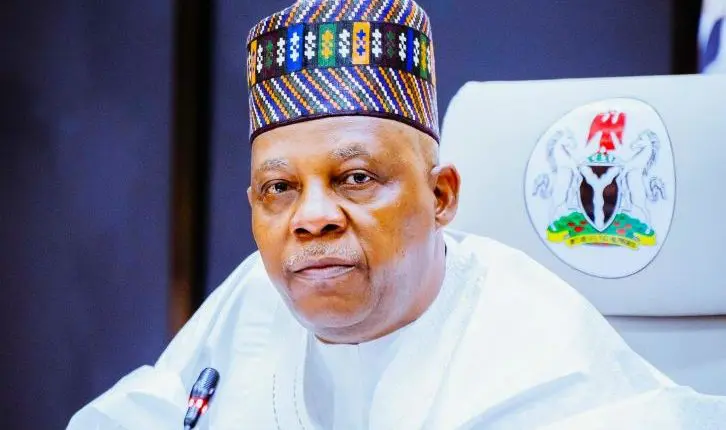
Nigeria’s Vice President, Kashim Shettima, has issued a strong warning to intending pilgrims for the 2026 Hajj, urging them to conduct themselves responsibly as they represent the country on the global stage.
Shettima gave the charge on Sunday during the official flag-off of the Hajj airlift at the Nnamdi Azikiwe International Airport in Abuja. The event marked the start of this year’s pilgrimage operations, with the first batch of about 500 pilgrims from Kogi State departing for Saudi Arabia.
The Vice President told the pilgrims that the Hajj is not only a religious obligation but also a national assignment, stressing that their behaviour abroad would reflect directly on Nigeria’s image.
“You are ambassadors of Nigeria. You carry with you the image of our nation and the dignity of our people. Let your conduct reflect discipline, humility, patience, and integrity,” he said.
The annual Hajj pilgrimage to Mecca is one of the five pillars of Islam and is expected of every Muslim who is physically and financially able to perform it at least once in their lifetime. Each year, millions of Muslims from around the world travel to Saudi Arabia for the exercise, making it one of the largest religious gatherings globally.
For Nigeria, which has one of the largest Muslim populations in Africa, participation in the Hajj is always significant. Authorities estimate that over 50,000 Nigerians will take part in the 2026 pilgrimage.
Speaking further, Shettima highlighted that while pilgrims are focused on spiritual activities, they must also respect the laws and customs of the host country, Saudi Arabia.
He warned that any misconduct could damage Nigeria’s reputation and affect future participation in the exercise.
“While you are on this sacred journey, you must remember that you are also representatives of our country. Obey the laws of the land and respect the rules guiding the pilgrimage,” he said.
The Vice President also explained that the success of the Hajj operation depends on both the government and the pilgrims. According to him, while the government is responsible for logistics, safety, and coordination, the pilgrims must play their part by following guidelines and maintaining discipline.
“Our duty is to ensure that every pilgrim undertakes this journey without avoidable hardship or anxiety,” he added.
He also reaffirmed the commitment of President Bola Tinubu to the welfare of Nigerians, both within the country and abroad, noting that the administration is working to improve the overall Hajj experience.
Other government officials present at the event echoed similar messages, focusing on the need for orderliness, cooperation, and prayer for the nation.
Kogi State Governor, Usman Ododo, urged the pilgrims to use the opportunity of the pilgrimage to pray for peace, unity, and development in Nigeria.
He reminded them that the country is facing various challenges and that their prayers could contribute to national progress.
Also speaking, the Minister of Aviation, Festus Keyamo, who was represented by Captain Mamud Abdullahi, assured that all necessary arrangements had been put in place to ensure smooth flight operations throughout the Hajj period.
He said the ministry has worked closely with relevant agencies to address issues such as flight scheduling, safety, and passenger handling, which have in the past caused delays and inconvenience to pilgrims.
In previous years, Nigerian pilgrims have faced challenges including flight delays, poor accommodation, and coordination problems. These issues have often drawn criticism and led to calls for reforms in the management of Hajj operations.
However, authorities say steps have been taken in recent years to improve planning and service delivery.
The Chairman of the National Hajj Commission of Nigeria, Ismail Abba Yusuf, also addressed the gathering, stating that the commission is committed to ensuring transparency and a smooth experience for all pilgrims.
According to him, NAHCON has introduced measures aimed at improving accountability and reducing the challenges faced by pilgrims in the past.
“We remain focused on improving transparency and ensuring a seamless experience for all pilgrims,” he said.
The Hajj airlift is a major logistical operation that involves coordination between federal and state governments, airlines, health officials, and Saudi authorities. It usually takes several weeks to transport all pilgrims to Saudi Arabia and bring them back after the exercise.
Pilgrims are typically grouped by states, with each state responsible for coordinating its participants through pilgrims’ welfare boards. These boards handle registration, orientation, and other preparations before departure.
Security agencies are also involved in ensuring the safety of pilgrims both during departure and upon arrival in Saudi Arabia.
Religious leaders often use the occasion to remind pilgrims of the spiritual significance of the journey, urging them to focus on prayers, self-discipline, and acts of worship.
For many Nigerians, performing the Hajj is a lifelong dream that requires years of planning and saving. As a result, expectations are usually high, both in terms of spiritual fulfilment and the quality of services provided.
The flag-off event in Abuja attracted government officials, religious leaders, and families of the pilgrims, many of whom came to bid farewell to their loved ones.
As the first batch of pilgrims departed, there was a sense of excitement and hope that this year’s exercise would be smoother and more successful than previous ones.
For the government, the focus remains on ensuring that all arrangements are properly managed, while for the pilgrims, the journey represents a unique opportunity for spiritual growth.
However, as Shettima’s message made clear, the responsibility goes beyond personal devotion. It also involves representing Nigeria with dignity and respect on the global stage.
As more flights are scheduled in the coming days, attention will remain on how well the process is managed and whether the expectations set by government officials will be met.
For now, the message from the Vice President is clear: Nigerian pilgrims must not only fulfil a religious duty but also uphold the values and image of the nation throughout their journey.