
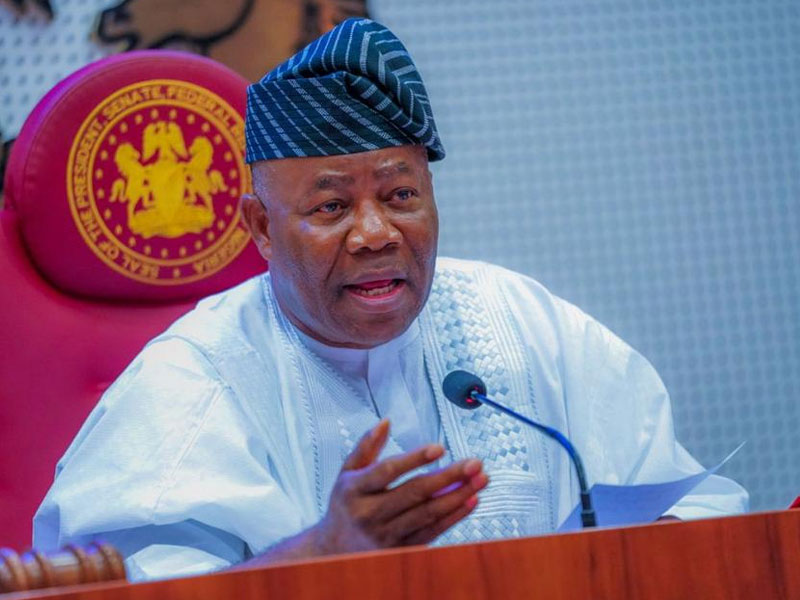
The President of the Senate, Godswill Akpabio, has warned state governors against abusing the proposed state police structure, saying strong safeguards must be put in place to prevent its misuse once it becomes operational.
Akpabio gave the warning on Tuesday during plenary at the Senate as the National Assembly moved closer to approving the creation of state police as part of ongoing efforts to tackle insecurity across Nigeria.
His comments came shortly after President Bola Tinubu transmitted a Constitution Alteration Bill to the National Assembly seeking the establishment of state police. The proposal is one of the most significant security reforms being considered in the country in recent years.
The Senate has fixed Wednesday for the passage of the state police bill, marking a major step in a debate that has lasted for decades.
Speaking during plenary, Akpabio acknowledged concerns that state police could be abused by governors and other political actors if adequate checks are not put in place. He stressed that lawmakers were aware of such fears and would ensure that the new policing system operates within a clear legal framework.
“Many of us like to go back home after we are through here, without being afraid of the state police,” Akpabio said.
He reminded governors that their time in office would eventually come to an end and that they could also become subject to the same institutions they create today.
“Even the current governors will one day leave office. They should not be afraid of the state police they created,” he stated.
The Senate President added that Nigeria has, since independence in 1960, maintained a highly centralized policing system. According to him, the proposed reform represents a historic effort to decentralize law enforcement and bring security operations closer to local communities.
“Since 1960, Nigeria did not have the courage to decentralize the police. This is the first time we’ll do it,” Akpabio said.
He explained that the process would be implemented in two stages. The first stage involves amending the Constitution to provide legal backing for state police. The second stage would involve the enactment of a separate law by the National Assembly to define operational guidelines and establish safeguards against abuse.
“And this will be done in two phases; one will be through alteration of the Constitution and the other one we will embed an Act of Parliament in order to bring out the modalities to avoid abuses,” he added.
The push for state police has gained momentum in recent years as insecurity continues to affect many parts of the country. Nigeria has faced several security challenges, including terrorism in the North-East, banditry in the North-West, kidnapping across various regions, communal clashes, farmer-herder conflicts, and rising criminal activities in urban centres.
Many governors, traditional rulers, security experts and civil society groups have argued that the current centralized police structure is overstretched and unable to respond effectively to local security threats. They believe state police would allow for quicker intelligence gathering and faster responses to crimes within communities.
Supporters of the proposal argue that governors, who are designated as chief security officers of their states, currently have limited control over police operations despite being held accountable by residents whenever security deteriorates.
However, opponents have consistently expressed fears that state police could be used to intimidate political opponents, suppress dissent and influence elections. Such concerns have remained one of the major reasons previous attempts to establish state police failed.
Successive administrations have debated the issue, but constitutional and political disagreements prevented any meaningful progress. The latest move by President Tinubu’s administration appears to have revived hopes that the long-standing proposal could finally become a reality.
The renewed push also follows growing calls from state governments and regional groups for greater control over security matters. Several states have already established local security outfits, including vigilante groups and regional security networks, to complement the efforts of federal security agencies.
While these outfits have recorded some successes, they do not possess the full powers of conventional police forces. Advocates of state police believe a constitutionally recognised structure would provide a more effective and coordinated approach to combating crime.
For now, lawmakers appear determined to move forward with the reform. Akpabio’s remarks suggest that while the National Assembly supports the creation of state police, it is also conscious of public concerns and intends to build safeguards into the system.
As the Senate prepares to take a final decision on the bill, many Nigerians will be watching closely to see whether the proposed reform can strike a balance between improving security and preventing political interference in law enforcement.