
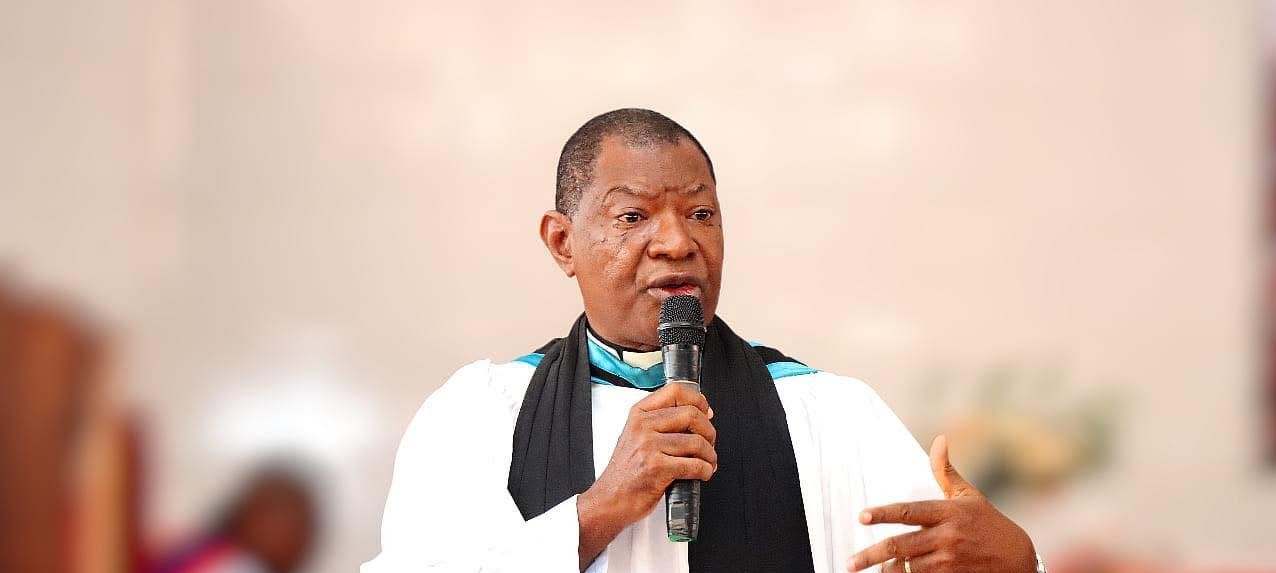
The Anglican Bishop of Enugu Diocese, Rt. Rev. Prof. Samuel Obiajulu Ike, has called on the Federal Government to end its policy of rehabilitating and reintegrating repentant terrorists into society, insisting that those involved in terrorism should be prosecuted instead of being offered a second chance.
The bishop made the call on Friday while delivering his presidential address at the third session of the 19th Synod of the Diocese held at St. Peter’s Anglican Church, Ogbete, Enugu.
Speaking on the state of the nation, Bishop Ike expressed deep concern over insecurity, the economy, electricity supply and governance, urging President Bola Tinubu’s administration to take urgent steps to restore public confidence.
On the issue of insecurity, the cleric argued that allowing former terrorists to return to society without facing justice sends the wrong message and weakens the country’s fight against violent crimes.
He urged the Federal Government to discontinue the reintegration program and instead ensure that those responsible for terrorism are brought before the courts.
According to him, justice must apply equally to all citizens regardless of the offence committed.
“In a society where a man is sentenced to death for defending himself against terrorists and another is prosecuted for stealing a goat, terrorists must also be made to face trial for their heinous crimes,” he said.
The bishop also urged President Tinubu to take decisive action against any cabinet members found to be sympathetic to terrorist groups.
He further called on the government to stop referring to members of Boko Haram as “insurgents” and instead officially designate them simply as terrorists.
According to him, using the correct description reflects the seriousness of the crimes committed by the group and reinforces the government’s determination to defeat terrorism.
Bishop Ike also appealed to the Federal Government to monitor and act against social media platforms allegedly being used by terrorist organisations to spread propaganda, recruit members and create fear among Nigerians.
He expressed concern over the continued wave of killings, kidnappings and attacks across different parts of the country.
Citing recent reports, the bishop said more than 1,100 Nigerians were kidnapped during the first quarter of 2026, while attacks in Plateau, Benue and Kaduna states claimed hundreds of lives.
He questioned why insecurity remained widespread despite the huge amount allocated to defence and security in the proposed 2026 budget.
According to him, the Federal Government earmarked N5.41 trillion for defence and security, representing about 9.3 per cent of the proposed N58.47 trillion budget, yet many Nigerians still feel unsafe.
The bishop also questioned the effectiveness of government spending on military equipment, including Tucano fighter jets, drones and other security hardware.
He said citizens deserve better protection considering the enormous resources committed to security.
“We renew our call on the President to act swiftly to ensure the protection of Nigerians. The 2027 elections are endangered if the government fails to guarantee the safety of its citizens,” he stated.
Beyond security, Bishop Ike expressed concern about Nigeria’s economic situation.
He criticised the Federal Government’s continued borrowing despite earlier assurances by President Tinubu that the country would reduce dependence on loans once revenue generation improved.
According to the cleric, it was difficult to understand why the government continued to borrow heavily despite presenting an ambitious N58.47 trillion budget.
He referred to the Senate’s approval of a fresh six-billion-dollar loan in March to finance the 2025 budget deficit.
The bishop questioned how borrowed funds had been utilised, arguing that ordinary Nigerians had yet to experience meaningful improvements in their living conditions.
He pointed to rising inflation, the continued depreciation of the naira, increasing poverty and the high cost of living as evidence that the government’s economic reforms had not delivered the expected results.
“There is increased pain, poverty and hunger in the land. Nigerians are disillusioned and disenchanted. The reforms appear not to have worked; rather, they have increased the cost of living. The Federal Government should rethink its policies and ensure they deliver tangible benefits to the masses,” he said.
The bishop also criticised the state of electricity supply across the country.
He lamented that power supply had remained unreliable despite the increase in electricity tariffs introduced under the customer band classification system.
According to him, many households and businesses continue to experience poor electricity despite paying higher bills.
Bishop Ike reminded the President of his campaign promise in 2023 that Nigerians would enjoy reliable and affordable electricity.
He said the time had come for that promise to be fulfilled, particularly after the Federal Government approved N3.3 trillion to clear long-standing debts in the power sector.
“The time to fulfil that promise was yesterday, and the next best time is now,” he said.
The cleric further argued that public confidence in the government’s commitment to improving electricity supply was weakened after the installation of a N10 billion solar power project at the Presidential Villa, popularly known as Aso Rock, in late 2025.
According to him, many Nigerians questioned why such a project was undertaken at the seat of government while millions of citizens continued to struggle with unstable electricity.
Bishop Ike called on the Federal Government to ensure that investments in the power sector translate into improved electricity for homes, businesses and industries across the country.
The Anglican bishop’s remarks come at a time when concerns over insecurity and the economy continue to dominate public discourse.
Nigeria has continued to battle terrorism in the North-East, banditry in parts of the North-West and North-Central, as well as kidnapping and other violent crimes in several regions.
At the same time, many Nigerians are grappling with rising food prices, inflation and the high cost of transportation following recent economic reforms.
Successive administrations have defended rehabilitation programs for repentant insurgents as part of broader efforts to encourage defections, gather intelligence and support long-term peace in conflict-affected areas.
However, the policy has remained controversial, with many victims of terrorism, civil society organisations and religious leaders arguing that those responsible for killings and destruction should first face justice before any consideration of rehabilitation.
Bishop Ike’s latest intervention adds to the growing calls from religious leaders and other stakeholders for stronger action against insecurity and more effective economic policies.
.