
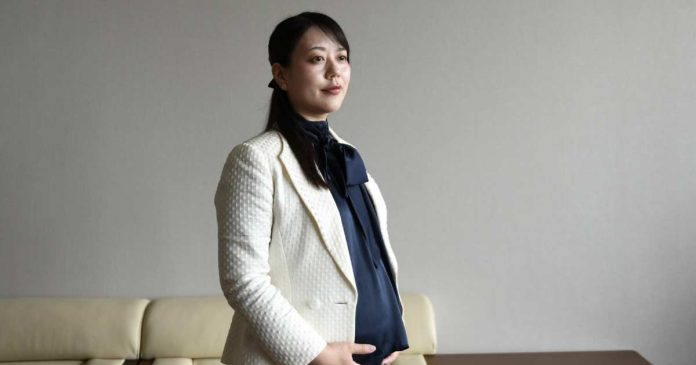
A decision by the mayor of a small town in Japan to take maternity leave has sparked a nationwide debate over whether elected public officials should be allowed to step away from office to have children, highlighting wider concerns about gender equality, work-life balance and the country’s declining birth rate.
Shoko Kawata, the 35-year-old mayor of Yawata, a town south of Kyoto, announced that she would temporarily hand over her responsibilities ahead of the birth of her first child.
While maternity leave is common for many workers in Japan, Kawata’s case has attracted unusual attention because there is no legal framework covering maternity leave for elected local officials.
Her decision has divided public opinion, with many praising her for setting an example for working women, while others argue that elected leaders should not take extended leave while in office.
Speaking to the BBC, Kawata admitted she was surprised by the scale of the reaction.
“I was so surprised because the reaction was so big,” she said.
The mayor announced her plans during a news conference in May, explaining that she would step away from her duties two months before her expected delivery in mid-September and remain away for two months after childbirth.
Although she described the period as maternity leave, it will not officially carry that status because Japanese law does not provide maternity leave for elected public office holders.
Instead, her deputy, Shigeto Nose, will temporarily exercise the powers of the mayor until she returns.
The arrangement will make Kawata the first mayor in Japan to take maternity leave while serving in office.
According to Kawata, colleagues at the Yawata City Hall supported her decision.
She said the average age of workers in the local government is about 39 years, and many understood the importance of balancing family life with public service.
However, outside the workplace, reactions have been sharply divided.
Thousands of comments on social media platform X and discussions on YouTube have reflected differing opinions about her decision.
Supporters argue that pregnancy and childbirth are important parts of life and that women should not be forced to choose between public office and raising a family.
Some described Kawata as a role model who could encourage more women to participate in politics.
Others said her decision exposes weaknesses in Japanese society, where workplace and political systems have not fully adapted to the needs of women.
Critics, however, argued that stepping away from official duties while serving as mayor is irresponsible.
Some suggested she should have postponed having children until after leaving office.
Others insisted that any public official taking extended leave should resign or have their salary reduced during the period of absence.
Despite the criticism, Kawata has remained firm.
She said becoming a mother and serving in public office should not be viewed as incompatible.
According to her, expecting women to avoid pregnancy while holding political office would effectively exclude many women from leadership positions.
“If we were to criticise politicians taking maternity leave, it means we are effectively excluding all women in their 20s through 40s — women who are capable of becoming pregnant — from public office,” she said.
Kawata believes society must evolve to allow women to pursue both careers and family life without facing discrimination.
“I think we really need to create a society where it’s so common for women to do both — and not have to choose between working and having a family,” she added.
The issue has also drawn comments from other political leaders.
Former Akitakata Mayor Shinji Ishimaru argued that the discussion should focus less on whether maternity leave is acceptable and more on ensuring government services continue smoothly during a mayor’s absence.
Speaking on his YouTube channel, Ishimaru said many people already support maternity leave, but practical arrangements should be developed to avoid disrupting municipal administration.
Yawata’s Deputy Mayor, Shigeto Nose, is expected to oversee the town’s affairs while Kawata is away.
He said he would exercise the mayor’s authority and discuss important issues with her remotely once every week.
Nose also reflected on changes in Japanese society regarding parenting.
The 62-year-old admitted that when his children were born, he took no parental leave and left childcare almost entirely to his wife.
“When I came home, I was tired. Even if the baby cried during the night, I left it to my wife. Looking back now, I genuinely feel that’s something I should reflect on,” he said.
He contrasted that experience with his son-in-law, who is currently taking six months off work to help care for his second child.
“Seeing that makes me happy. Times have really changed and it’s great to see them working together like that,” he added.
Kawata’s case has reignited discussions about the role of women in Japanese politics.
She became Japan’s youngest female city mayor at the age of 33 after graduating from Kyoto University with a degree in economics.
Before entering politics, she built a career in local government and has become one of the country’s most recognisable young female political leaders.
Despite progress in recent years, women remain significantly underrepresented in Japanese politics.
Official figures show that only about four per cent of Japan’s 1,720 municipal leaders were women as of last year.
Japan has long struggled to improve female representation in leadership positions.
Although the country recently welcomed its first female prime minister, women’s participation in politics remains among the lowest in developed nations.
A survey released by Japan’s Cabinet Office in July 2025 identified pregnancy, gender stereotypes and political harassment as some of the biggest obstacles preventing women from entering politics.
The report found that many women continue to face assumptions that politics is a profession mainly for men.
The issue comes as Japan battles one of the world’s lowest birth rates and an ageing population.
For years, successive governments have introduced policies aimed at encouraging more births by expanding childcare support, improving parental leave and providing financial assistance to families.
Under Japanese law, women are entitled to six weeks of maternity leave before childbirth and eight weeks after delivery.
Parents may also take childcare leave until a child reaches one year of age, with partial salary support provided during the leave period.
Despite these benefits, many workers, especially men, still do not fully utilise parental leave because of workplace culture and social expectations.
According to the World Economic Forum’s 2025 Global Gender Gap Report, Japan ranked 118th out of 146 countries, making it the lowest-ranked member of the G7 on gender equality.
It has evolved into a national conversation about leadership, family life, gender equality and whether modern political institutions should adapt to changing social realities.
For Kawata, however, the issue remains simple.
She hopes that by the time her child grows up, a woman serving as a mayor while raising a family will no longer be seen as unusual, but as a normal part of society.