
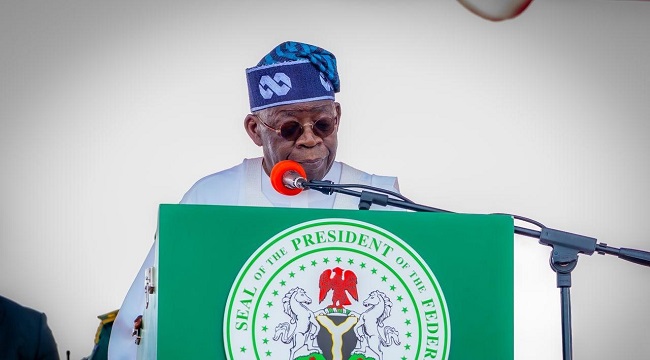
President Bola Tinubu has urged Nigerian journalists and media organisations to avoid becoming channels for the propaganda of terrorists, bandits and kidnappers, warning that irresponsible reporting could undermine the country’s efforts to tackle insecurity.
The President made the appeal on Thursday while speaking at the inaugural State House Press Corps Presidential Dinner held at the Presidential Villa in Abuja.
Addressing journalists covering the Presidency, Tinubu acknowledged the important role of the media in a democratic society but stressed that the responsibility of informing the public must be balanced with the need to protect national security.
He said the media should remain professional and avoid giving publicity to criminal groups whose actions are aimed at spreading fear among citizens.
“The media must resist the temptation of becoming megaphones for terrorists and kidnappers,” the President said.
He warned that reports capable of promoting the activities or messages of criminal groups could weaken national efforts to restore peace and security.
“We must not undermine our country with irresponsible reporting. If we do, we will have no safe space left, especially at a time when our nation is tackling security threats, neutralising thousands of criminal elements, and rescuing hostages,” Tinubu said.
According to the President, terrorists and bandits often rely on fear and publicity to achieve their objectives, making it important for the media to exercise caution when reporting security-related issues.
“The media should not become an amplifier for those who wish to harm us,” he added.
Tinubu, however, reaffirmed the importance of press freedom and accountability in democratic governance.
He noted that while the government has the responsibility of protecting citizens and implementing policies, the media also has the duty to scrutinise government actions and keep the public informed.
“The government must act, the media must watch, the government must explain, and the media must question,” the President said.
His remarks highlighted what he described as the need for a healthy relationship between government institutions and the media, where both sides perform their constitutional responsibilities without compromising the national interest.
The inaugural Presidential Dinner brought together members of the State House Press Corps, senior government officials and media executives for an evening of engagement at the Presidential Villa.
President Tinubu attended the event alongside his Chief of Staff, Femi Gbajabiamila, while other senior officials of the administration were also present.
The gathering was organised to appreciate journalists assigned to cover the Presidency and to strengthen communication between the government and the media.
The event came at a time when Nigeria continues to face multiple security challenges, including terrorism in the North-East, banditry in the North-West and North-Central, kidnapping for ransom, communal violence and other forms of organised crime.
Although security agencies have reported successes in recent months, attacks by armed groups continue to affect many communities across the country.
The Federal Government has repeatedly stated that military operations have led to the elimination of thousands of terrorists and other criminal elements, while hundreds of kidnapped victims have also been rescued through coordinated operations involving the Armed Forces and other security agencies.
Despite these gains, insecurity remains one of the major concerns of many Nigerians.
The media has played a central role in reporting security developments, providing updates on attacks, rescue operations and government responses.
However, debates have continued over how security issues should be reported without unintentionally promoting the objectives of criminal groups.
At the same time, media organisations have consistently maintained that accurate and timely reporting is essential in keeping citizens informed and holding public officials accountable.
Tinubu’s remarks reflected the delicate balance between national security and press freedom, two principles that remain important in every democratic society.
Nigeria’s Constitution guarantees freedom of expression and freedom of the press, allowing journalists to report matters of public interest.
At the same time, media professionals are expected to uphold ethical standards by ensuring that reports are accurate, balanced and do not endanger public safety.
Professional bodies, including the Nigeria Union of Journalists (NUJ) and the Nigerian Guild of Editors (NGE), have repeatedly urged journalists to verify information before publication, especially during security emergencies, to avoid spreading misinformation or panic.
Tinubu’s address underscored the need for continued cooperation between the government and the media in addressing Nigeria’s security challenges.
He highlighted that while journalists must continue asking difficult questions and demanding accountability from public officials, they should also be mindful of the broader national interest when reporting issues relating to terrorism, banditry and kidnapping.
As Nigeria continues its fight against insecurity, the relationship between government and the media is expected to remain crucial in ensuring that citizens receive accurate information while denying criminal groups the publicity they seek.
The President’s appeal to journalists therefore serves as a reminder of the important role the media plays, not only in strengthening democracy but also in supporting national efforts to build a safer and more secure country.